Title: Theoretical description of electron-beam spectroscopies: a newcomer’s guide
When: Thursday, December 3, 2026, 15:00
Place: Department of Condensed Matter Physics, Faculty of Sciences, Module 3, Seminar Room (5th floor).
Speaker: Christos Tserkezis, University of Southern Denmark
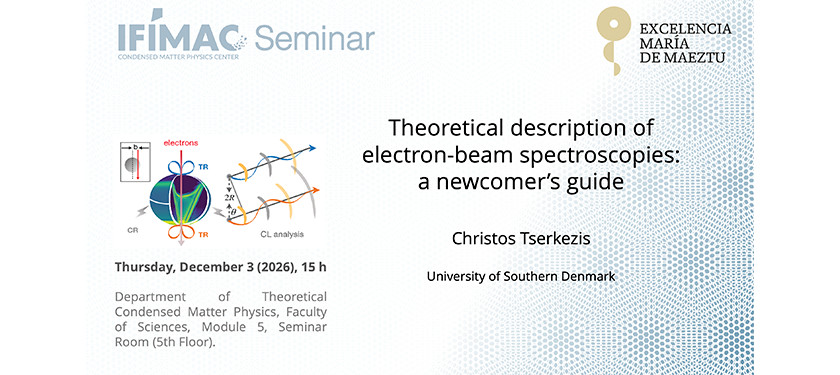
Electron-beam spectroscopies have been established as important complementary techniques to optical microscopy in nanophotonics. Electron-energy loss spectroscopy (EELS) played a fundamental role in the understanding and development of plasmonics since its very nascent days, because swift electron beams constitute extremely broadband localised excitations, that can overcome momentum mismatch or symmetry limitations in exciting optical modes. Its sibling, cathodoluminescence (CL) spectroscopy, is ideal for exploring the radiative part of the optical response of a system, and thus visualising the corresponding local density of optical states. Both techniques are nowadays implemented to study all kinds of nanophotonic structures, including Mie-resonant high-index dielectrics. To fully exploit their potential, theoretical descriptions that can reproduce experimental measurements and identify the different contributions to the corresponding spectrum are required. Here I will first review some of the analytic and numerical approaches developed for EELS and CL simulations in the past. I will then focus on our recent work on the analytic description of penetrating electron beams [1,2], and on the insight that can be gained by time-domain simulations [3], as revealed by analysing the response of plasmonic and dielectric nanospheres [4,5], and their coupling with excitonic materials [6]. [1] P. E. Stamatopoulou et al., Phys. Rev. Res. 6, 013239 (2024). [2] P. E. Stamatopoulou et al., J. Opt. Soc. Am. B 42, 1620 (2025). [3] W. Zhao et al., ACS Photonics 13, 10.1021/acsphotonics.6c01605 (2026). [4] S. Fiedler et al., Nano Lett. 22, 2320 (2022). [5] Y. Lebsir et al. arXiv: 2605.11661 (2026). [6] A. Brandt et al., Phys. Stat. Sol. (a) 223, e70469 (2026).