


Title: Cell-Surface Functionalization Modulates Collective Cell Behavior
When: Monday, January 12, 2026, 12:00
Place: Department of Theoretical Condensed Matter Physics, Faculty of Sciences, Module 5, Seminar Room (5th Floor)
Speaker: Prasoon Awasthi/University of Southern Denmark
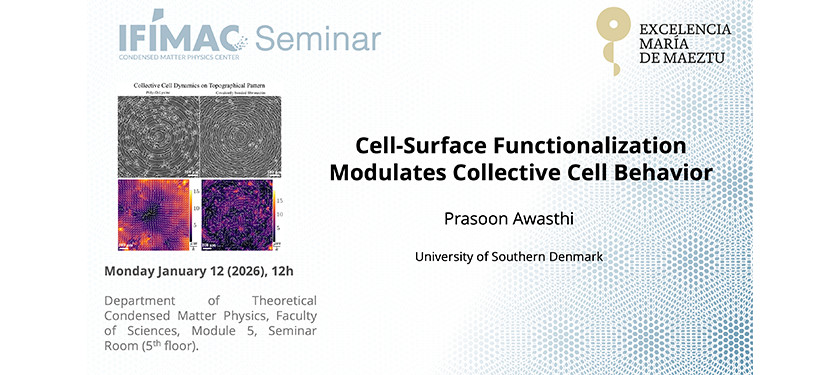
Living cells establish long-range orientational order through collective alignment, wherein topological defects emerge as singularities. The functional relevance of these defects has been increasingly recognized in key biological processes, including tissue organization and morphogenesis. Researchers have also induced topological defects in cell monolayers by employing engineered topographical patterns to mimic natural biological phenomena. In this study, we demonstrate that the collective behavior of cell monolayers near defects can be regulated by modifying the extracellular matrix (ECM). We investigated the dynamics of NIH 3T3 fibroblast cells on a topographic ring pattern comprising short micro-ridges shaped as concentric circular rings made of PDMS coated with two different ECMs, fibronectin (FN) and poly-D-lysine (PDL). This ring pattern generates vortex integer topological defects in the cell monolayer. Our analysis of cell dynamics shows that cells on PDL exhibit pronounced inward radial motion after reaching confluency. In contrast, cells on FN primarily move along the ridges in an azimuthal direction, with slower radial movement. We observed that cells on PDL exhibit weaker surface adhesion compared to those on FN. This difference in adhesion results in a more spread-out morphology for cells on PDL, whereas cells on FN adopt a spindle-like shape. The spindle morphology correlates with a higher nematic order parameter, as determined from the orientation field of the cells post-confluency. Furthermore, the spindle shape of cells leads to the formation of two +1/2 topological defects. We further characterize collective cell dynamics by analyzing correlation lengths and demonstrate the scaling of number density fluctuations in cell systems.