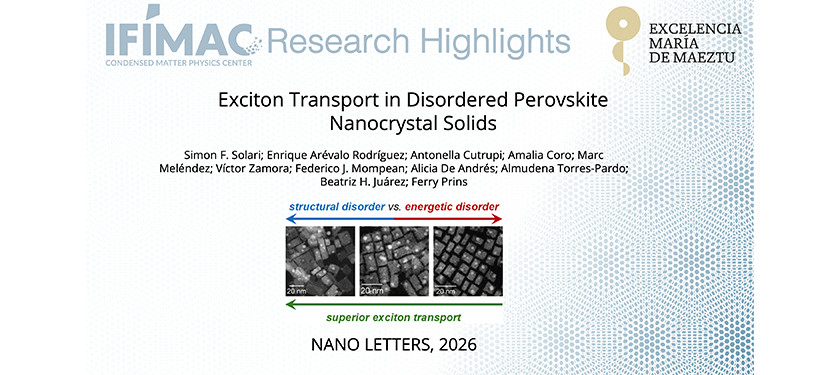
Energetic Disorder, Not Size Variation, Limits Energy Transport in Perovskite Nanocrystal Films Films made from colloidal lead halide perovskite nanocrystals are promising low-cost materials for LEDs, lasers and solar cells. Inside these films, energy moves as excitons, which are bound electron–hole pairs that hop from one nanocrystal to the next. The nanocrystals are never perfectly uniform, so the films are disordered, but, to date, it was not clear how this disorder affects exciton transport. Researchers at IFIMAC and the Universidad Autónoma de Madrid (UAM), working with ICMM-CSIC, IMN-CNM-CSIC and the Universidad Complutense de Madrid, tracked excitons in space, time and energy. They found, surprisingly, that the films with the most uniform nanocrystals transport energy the worst. In these smaller crystals, quantum confinement turns tiny size differences into large energy differences, which trap excitons in low-energy sites. As a result, the diffusion length falls from 81 nm to 30 nm. The work shows that the choice of surface ligand is key to designing better devices, and it was published in Nano Letters. [Full Article]