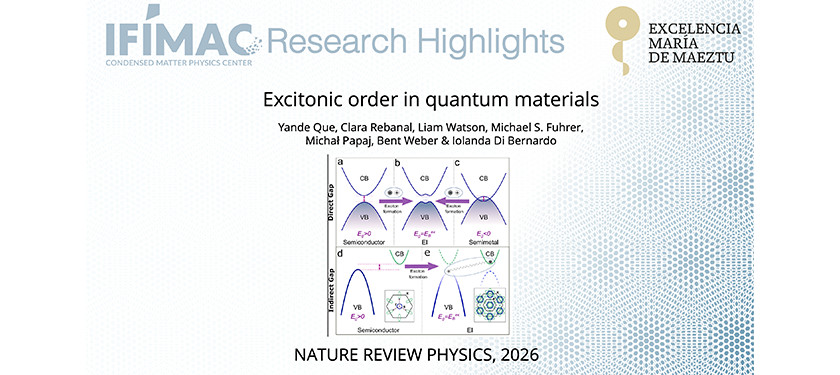
The excitonic insulator is a many-body ground state of condensed, spontaneously formed excitons (electron–hole pairs) in equilibrium. Unlike conventional band or Mott insulators, excitonic insulators are difficult to realize experimentally and demonstrate unambiguously. In recent years, the concept has gained renewed experimental traction thanks to advances in spectroscopic resolution, ultrafast probes and materials synthesis. In this Review, we outline the essential theoretical ingredients underpinning excitonic order and then examine the diverse experimental fingerprints of the excitonic state. We propose strategies to disentangle excitonic order from competing phases such as charge density waves, Mott insulating states and hybridization-driven insulators. We survey the rapidly expanding family of candidate materials, from layered chalcogenides in 2D and 3D to artificial excitonic platforms. Finally, we discuss the key challenges and emerging opportunities in the field, identifying the theoretical and experimental frontiers that promise to shape the next decade of research. [Full Article]