


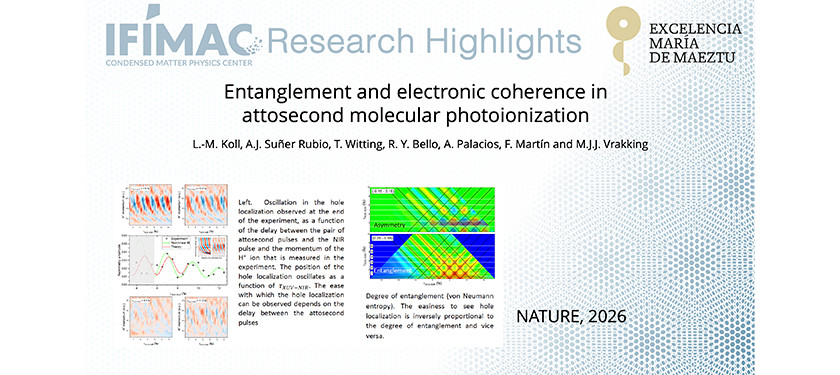
Attosecond extreme-ultraviolet (XUV) pulses, with photon energies exceeding the binding energies of any conceivable compound (atom, molecule, liquid or solid), lead to photoionization and the formation of a bi-partite system, i.e. an ion and a photoelectron. These will be entangled whenever the total wave function cannot be written as a single direct product of wave functions describing the ion and the photoelectron. In our experiments, hydrogen molecules (H2) were ionized using a pair of attosecond pulses in combination with a longer infrared pulse. This leads to an ultrafast motion of the hole created in the molecule upon the photoelectron departure, which implies the existence of electronic coherences in the residual ion. By varying the time delay between the pair of attosecond pulses and the infrared pulse, an oscillation in the position where the hole was preferentially placed at the end of the experiment was observed. With the solid support of nearly-exact simulations, we showed that entanglement in the (H2+ ion + photoelectron) system occurs at the expense of the electronic coherence in the remaining H2+ molecular ion, thus revealing attosecond control of coherences and entanglement in the molecule by just varying the delay between the pulses. The work demonstrates how to increase (or decrease) the degree of quantum entanglement in molecular systems on the attosecond time scale, with potential impact for further developments in quantum information technologies. This work results from the close collaboration between members of IFIMAC (Prof. A. Palacios), IMDEA Nanociencia and UAM in Madrid and the Max-Born Institute in Berlin. [Full Article]