

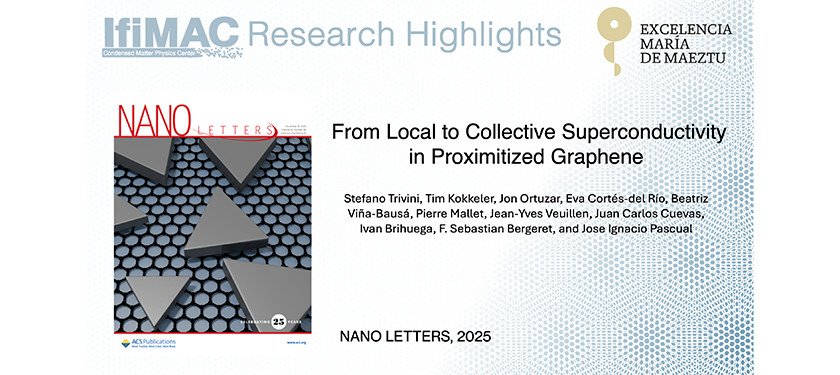
Researchers from IFIMAC (UAM) and CIC nanoGUNE, together with international collaborators, have shown how to transform graphene from hosting only local superconducting “patches” into a fully collective superconducting state engineered by nanoscale lead islands. Superconductivity was induced in graphene via the proximity effect, whereby the graphene inherits some of the superconducting properties of the nanoscale Pb islands deposited on top of it. Using a low-temperature scanning tunnelling microscope, they manipulated individual Pb islands on graphene and measured how superconductivity spreads through the carbon layer, revealing that the conductance of the Pb/graphene interface is the key parameter that switches between local and collective behaviour. Their results, featured on the cover of Nano Letters under the title “From Local to Collective Superconductivity in Proximitized Graphene”, provide a practical recipe for designing tailor-made superconducting phases in two-dimensional materials, with promising implications for future quantum and nanoelectronic devices. [Full Article]