


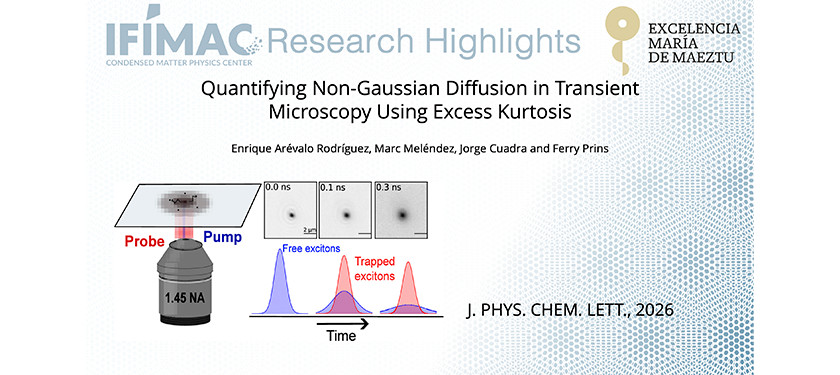
Transient microscopy techniques have emerged as powerful tools for imaging charge carrier dynamics with nanometer-scale spatial and subnanosecond temporal resolution. However, extracting quantitative transport properties typically relies on fitting carrier distributions to Gaussian profiles – an assumption that can break down when multiple species coexist or when anomalous diffusion processes dominate. Here, we employ transient scattering microscopy to visualize exciton transport in bulk tungsten diselenide and demonstrate that exciton populations exhibit significant deviations from Gaussian behavior. By analyzing the excess kurtosis of the spatial distributions, we reveal a characteristic temporal evolution: heavy-tailed profiles at early times transition to flat-topped distributions at later times. Through systematic variation of laser repetition rate and excitation fluence, combined with numerical simulations, we attribute early positive kurtosis to residual populations from previous laser pulses and late negative kurtosis to the presence of shallow trap states. Importantly, we show that conventional Gaussian fitting yields unphysical power-dependent diffusivities, whereas a discrete variable approach consistently recovers diffusivity values of approximately 4 cm²/s across all conditions. Our results establish kurtosis as a sensitive diagnostic parameter for identifying non-Gaussian diffusion and demonstrate the necessity of moving beyond Gaussian approximations in the analysis of transient microscopy data. [Full Article]