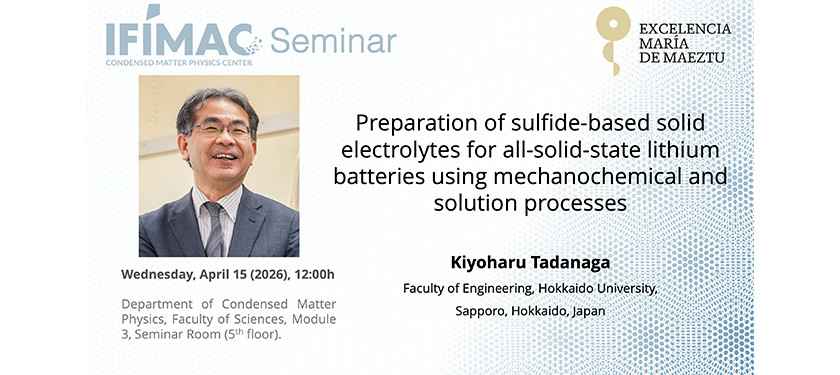
Title: Preparation of sulfide-based solid electrolytes for all-solid-state lithium batteries using mechanochemical and solution processes
When: Wednesday, April 15, 2026, 12:00
Place: Department of Theoretical Condensed Matter Physics, Faculty of Sciences, Module 3, Seminar Room (5th Floor)
Speaker: Kiyoharu Tadanaga / Faculty of Engineering, Hokkaido University, Sapporo, Hokkaido, Japan
All-solid-state lithium secondary batteries using inorganic solid electrolytes are garnering significant attention as next-generation energy storage devices due to their potential for higher energy density, improved safety, and reliability. Among various solid electrolytes, sulfide-based solid electrolytes are particularly promising due to their high lithium-ion conductivity and favorable mechanical properties, which enable good interfacial contact between electrodes and electrolytes. Sulfide-based solid electrolytes originated from research on glassy materials prepared by melt-quenching around the 1990s. Since the early 2000s, mechanochemical synthesis has been widely used to prepare these materials. In the 2010s, liquid-phase synthesis of sulfide solid electrolytes began to attract attention due to expectations for large-scale production and improved interfacial contact [1]. In the preparation of sulfide-based solid electrolytes using solution processes, there are mainly two approaches. One is the dissolution–precipitation of a sulfide solid electrolyte precursor obtained by other processes, such as solid-state reactions or mechanical milling. The other is a suspension reaction of the precursors without any prior mechanochemical treatment. This presentation will introduce the historical development of sulfide-based solid electrolytes, the evolution of their synthesis methods, and recent research trends related to their application in all-solid-state batteries. [1] A. Miura, N.C. Rosero Navarro, K. Tadanaga et al., Nature Review Chemistry, 3, 189-193 (2019). DOI: https://doi.org/10.1038/s41570-019-0078-2.