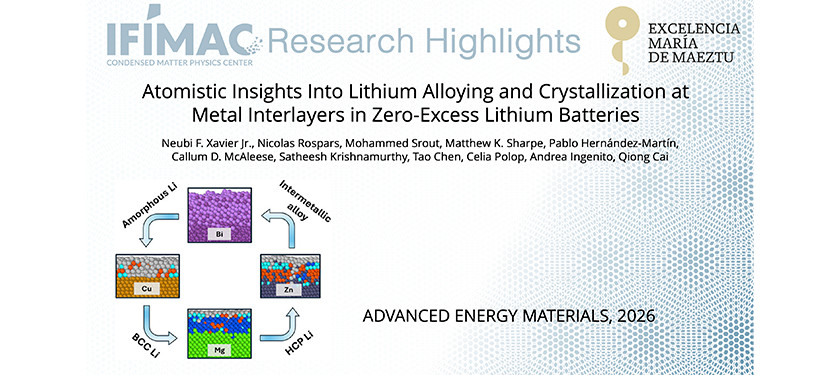
Zero-excess lithium batteries (ZELBs), in which the anode is formed in situ during charging, offer a promising route to overcome the safety and cost limitations of conventional lithium metal batteries. However, non-uniform lithium nucleation on copper current collectors often leads to dendrite formation and rapid degradation. Here, we combine fine-tuned machine-learning interatomic potentials with large-scale molecular dynamics simulations to resolve the atomistic pathways of lithium alloying and crystallization on Cu and interlayer metals (Zn, Mg, and Bi). On Cu, lithium nucleates through metastable disordered, HCP, and FCC phases before stabilizing into BCC lithium, whereas Zn and Mg interlayers promote alloy-mediated crystallization, enhancing lithium diffusion and structural uniformity. Distinctly, Bi forms ordered Li3Bi intermetallics with limited interfacial coherence. Experimental validation through scanning electron microscopy, x-ray diffraction, atomic force microscopy, and time-of-flight elastic recoil detection corroborates the predicted alloying and phase evolution. The results reveal that interlayer-dependent alloying dynamics govern lithium crystallization and morphology, establishing a direct link between interfacial chemistry, diffusion behavior, and deposition uniformity. These insights provide a general atomistic framework for rationally designing metal interlayers that regulate lithium nucleation and enable stable and high-efficiency operation of next-generation zero-excess lithium batteries. [Full Article]