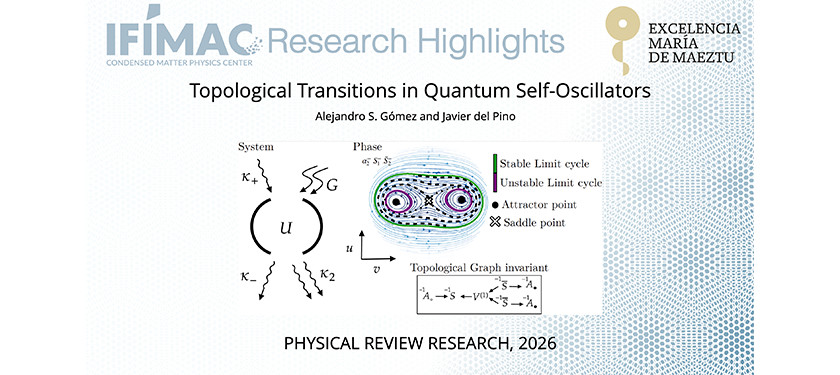
Self-oscillators are ubiquitous across physics, from lasers and electronic circuits to nanomechanical, photonic, and quantum platforms. Yet their phases are not fully captured by steady states or spectra alone: they are shaped by the global organization of phase-space flow, including fixed points, limit cycles, basins, and relaxation routes. Here, we build a topological classification of quantum self-oscillatory phases. Starting from the classical mean-field flow, we identify the fixed points and limit cycles, determine how their stable and unstable manifolds connect, and encode this information in a graph invariant called the molecule. This invariant captures both connectivity and chirality, allowing us to track dynamical phase transitions, when the global structure of the flow changes. Using this construction, we identify global dynamical phase transitions that are invisible or weakly visible in the Liouvillian spectrum, including in the gap and excited eigenvalues. Although spectrally subtle, these transitions produce clear changes in transient quantum dynamics and relaxation pathways. The result is a practical topological diagnostic for dynamical phases beyond standard Liouvillian indicators. [Full Article]