

Title: Defect-induced Multiferroicity in Transition-Metal Dichalcogenides
When: Tuesday, July 14, 2026, 13:00
Place: Department of Condensed Matter Physics, Faculty of Sciences, Module 3, Seminar Room (5th floor)
Speaker: José Augusto Galvis Echeverri, Universidad del Rosario (Colombia)
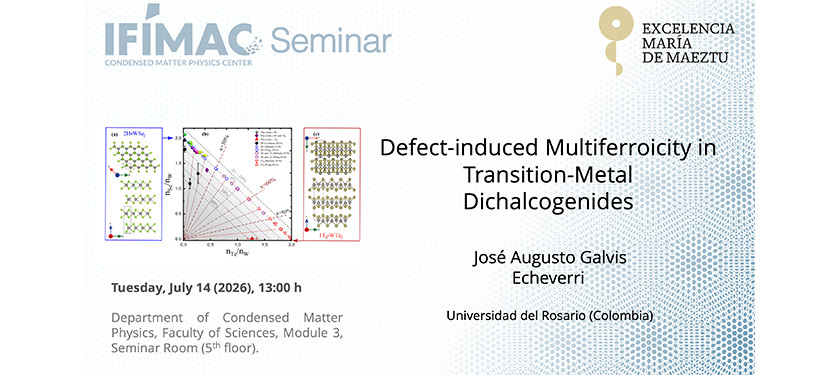
Transition-metal dichalcogenides constitute a versatile platform for engineering ferroic phenomena at the atomic scale due to their tunable crystal and electronic structure. In this work, we investigate the structural, magnetic, and ferroelectric properties of bulk solid-solution W(Se₁₋ₓTeₓ)₂(1−δ) single crystals[1]. The influence of tellurium substitution (x) and chalcogen deficiency (δ) on room-temperature ferroic behavior is systematically explored. Structural characterization by X-ray diffraction and Raman spectroscopy reveals lattice expansion and symmetry lowering with increasing Te content, leading to a 2H-to-1Td structural transition. Piezoresponse force microscopy demonstrates piezoelectric behavior near stoichiometric compositions and switchable ferroelectricity in samples with high chalcogen-vacancy concentrations. Magnetometry measurements show a concurrent evolution from paramagnetic to ferromagnetic behavior as δ increases. While Te substitution primarily controls crystal symmetry, chalcogen vacancies drive the emergence of both ferroelectric and ferromagnetic responses. As a result, multiferroic states arise in highly deficient compositions through the coexistence of ferroelectric and ferromagnetic ordering. These observations are summarized in a configurational phase diagram that highlights the cooperative role of chemical substitution and defect engineering in tailoring ferroic properties. Our results demonstrate that stoichiometry and vacancy control provide an effective route for designing multifunctional ferroic states in layered transition-metal dichalcogenides. [1] H. Rojas-Páez, G. Villabón-Linares, J. Pazos, E. Ramos, R. Moreno, O. Herrera-Sandoval, J. A. Galvis and P. Giraldo-Gallo. [Article]