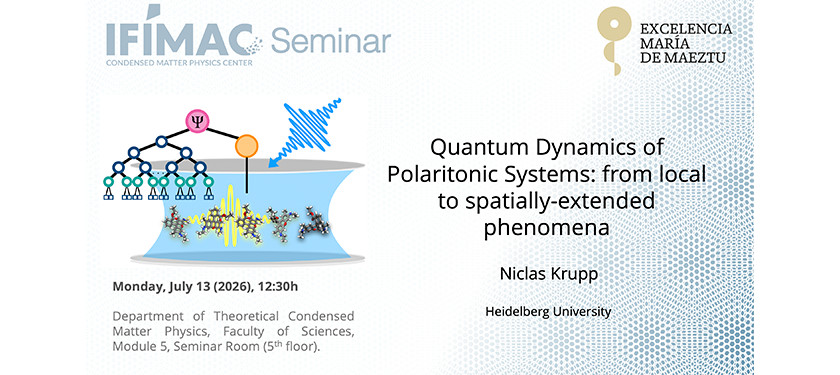
Title: Quantum Dynamics of Polaritonic Systems: from local to spatially-extended phenomena
When: Monday, July 13, 2026, 12:30
Place: Department of Theoretical Condensed Matter Physics, Faculty of Sciences, Module 5, Seminar Room (5th Floor)
Speaker: Niclas Krupp, Heidelberg University
Strong light-matter platforms such as nanophotonic resonators and Fabry-Pérot cavities are promising candidates for realizing enhanced energy transport, polariton lasing, and even mode-selective chemistry, among others. Yet, the actual scope and reproducibility of these effects remain subjects of intense debate. In particular, identifying and understanding cavity-induced modifications in the collective strong coupling regime with large numbers of emitters poses a major challenge to both experiment and theory. Numerically accurate quantum dynamical simulations of polaritonic systems provide valuable microscopic insights as well as reliable benchmark results for more approximate methods. By adapting the multi-layer multiconfiguration time-dependent Hartree (ML-MCTDH) method to light-matter wavefunctions, we can access the full quantum dynamics from few-molecule to spatially extended scales based on a variationally optimal tree-tensor network decomposition [1,2]. Recent developments further extend this framework to finite temperatures [3]. Using these simulations, we explore the possibilities and limitations of polaritonic effects in the limit of large ensembles. This talk will discuss two illustrative examples: the cavity-induced modification of local molecular structure and exciton-polariton transport in Fabry-Pérot cavities.
[1] Krupp, N., Groenhof, G. & Vendrell, O. Quantum dynamics simulation of exciton-polariton transport. Nat. Commun. 16, 5431 (2025).
[2] Krupp, N., Huber, M., Luo, C. & Vendrell, O. First principles simulation of the collective rovibronic ground state in a cavity, Phys. Rev. Research 8(1), 013118 (2026).
[3] Krupp, N. & Vendrell, O., in preparation