Title: Low-dimensional materials for sensing
When: Friday, September 18, 2026, 12:00
Place: Module 3, Sala de Seminarios, FMC
Speaker: Sara Gullace/Universidad Autónoma de Madrid
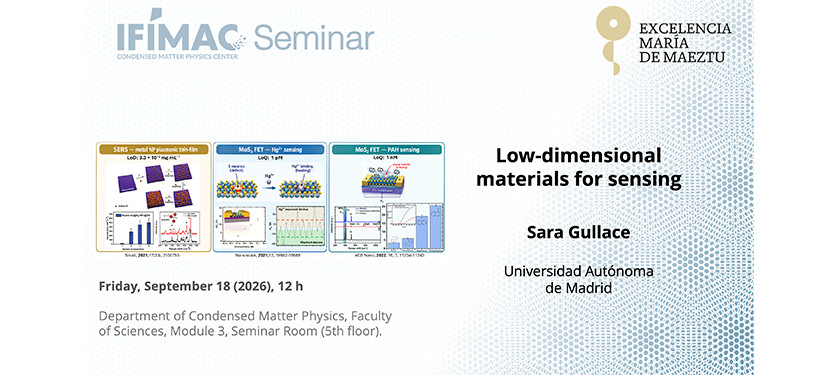
The contamination of soil, water sources, and air, resulting from the rapid industrial development and the growing world population, has become a major worldwide concern. Fast and precise sensors for air and water quality monitoring are required for tracking the activity of power plants and the oil and gas industries, with a specific focus on their impact on nature. This monitoring can take place via the identification and quantification of trace concentrations of toxic heavy elements and molecular contaminants. Low-dimensional materials are ideal scaffolds for the development of highly sensitive and selective sensors which are unexpensive and easy to fabricate, enabling fast and reliable detection of specific chemical species in liquid and gas media. Due to their nanometric size and high surface-to-volume ratio, they exhibit quantum confinement effects combined with other exclusive properties such as extraordinary thermal and electrical conductivity, markedly high catalytic activity, and unique optical properties making them extremely reactive and suitable candidates for environmental pollution sensing and remediation. In particular, metal nanoparticles (NPs) and 2D transition metal chalcogenides are considered ideal sensory materials, since their unique physical and chemical properties are highly sensitive to environmental changes. In this talk, I will present an overview of my recent contribution to this field, spanning from the development of universal label-free surface enhanced Raman scattering (SERS) sensors [1], to field-effect transistors sensing devices for the detection of heavy metal ions [2] and polycyclic aromatic hydrocarbons [3], showing how multiscale characterization enables the definition of the sensing mechanism and the sensor figures of merit. [1] S. Gullace, V. Montes‐García, V. Martín, D. Larios, V. Girelli Consolaro, F. Obelleiro, G. Calogero, S. Casalini, P. Samorì, 2021, Small, 17(33), 2100755 [2] F. Jiménez Urbanos, S. Gullace, P. Samorì, 2021, Nanoscale, 13, 19682-19689 [3] F. Jiménez Urbanos‡, S. Gullace‡, P. Samorì, 2022, ACS Nano, 16, 7, 11234–11243.