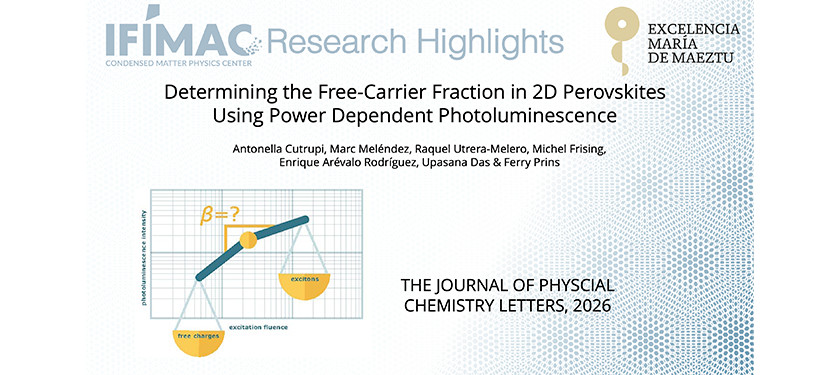
Determining the nature of the optical excited state (excitons or free carriers) in nanostructured materials is crucial for device design, as optoelectronic and photovoltaic technologies require different considerations regarding the optimized excited state dynamics. Power-dependent photoluminescence is widely used to distinguish between excitons and free carriers, but the classical power-law analysis oversimplifies the underlying physics when the exponent lies between the linear (pure excitons) and quadratic (pure free carriers) limits. In this work, we present a complete study enabling a direct and quantitative analysis of the free-carrier fraction based on power-dependent peak photoluminescence and placing its analysis in the context of the Saha equation. We study Ruddlesden–Popper perovskites with varying thickness as a model system, as they cover a wide range of exciton binding energies and the full range of free carrier fractions. Our results agree with previously reported values for the exciton binding energies in these materials, confirming the reliability of this approach and providing a simple and effective tool for probing the nature of optically excited states in semiconductors with intermediate exciton binding energies. We demonstrate that our method allows probing spatial variations in the fraction of free charges near grain boundaries or edges at micrometer spatial resolution. Finally, our results highlight the importance of performing optical characterization under excitation densities relevant to realistic operating conditions, as higher fluences can artificially enhance exciton formation and distort excited-state interpretation under solar-fluence conditions. [Full Article]