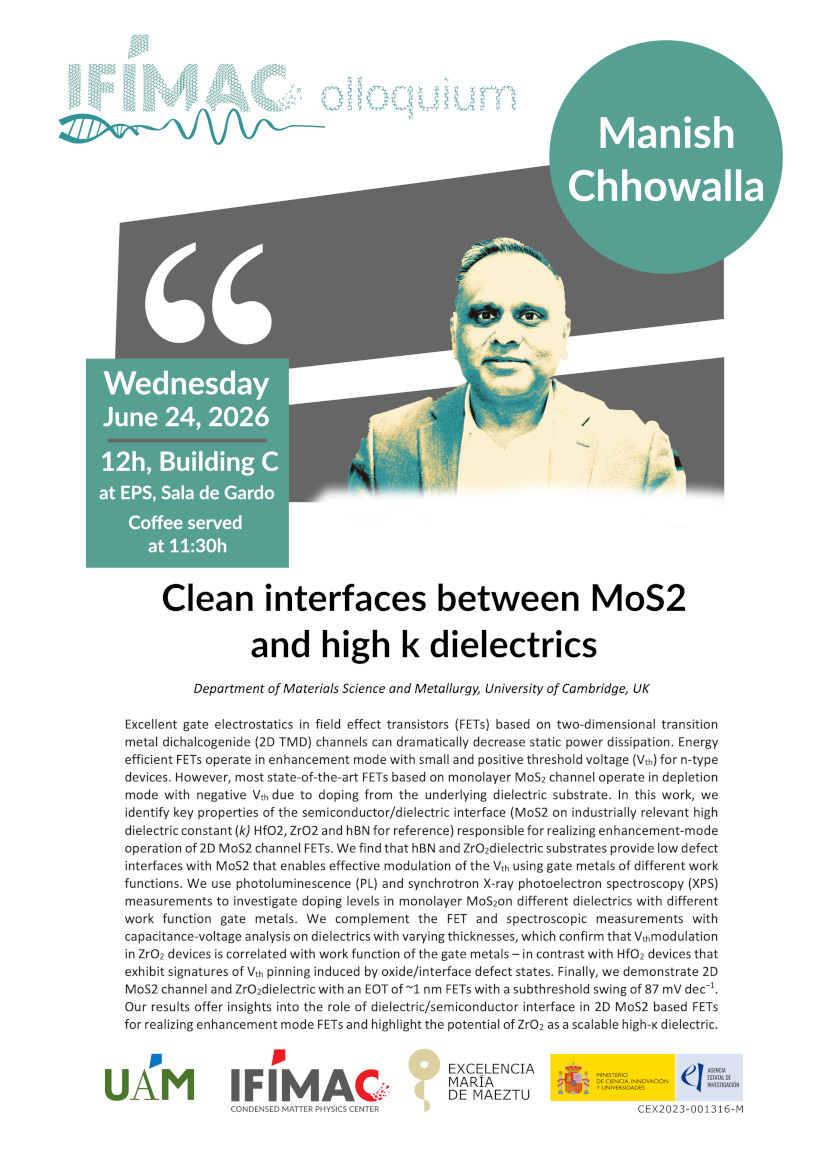


Event Type: IFIMAColloquium
Title: Clean interfaces between MoS2 and high k dielectrics
When: Wednesday, 24th June, 2026, at 12:00h
Where: Sala de Grados, Building C, Escuela Politécnica Superior, Universidad Autónoma de Madrid
Speaker: Manish Chhowalla, Department of Materials Science and Metallurgy, University of Cambridge, UK.
Excellent gate electrostatics in field effect transistors (FETs) based on two-dimensional transition metal dichalcogenide (2D TMD) channels can dramatically decrease static power dissipation. Energy efficient FETs operate in enhancement mode with small and positive threshold voltage (Vth) for n-type devices. However, most state-of-the-art FETs based on monolayer MoS2 channel operate in depletion mode with negative Vth due to doping from the underlying dielectric substrate. In this work, we identify key properties of the semiconductor/dielectric interface (MoS2 on industrially relevant high dielectric constant (k) HfO2, ZrO2 and hBN for reference) responsible for realizing enhancement-mode operation of 2D MoS2 channel FETs. We find that hBN and ZrO2dielectric substrates provide low defect interfaces with MoS2 that enables effective modulation of the Vth using gate metals of different work functions. We use photoluminescence (PL) and synchrotron X-ray photoelectron spectroscopy (XPS) measurements to investigate doping levels in monolayer MoS2on different dielectrics with different work function gate metals. We complement the FET and spectroscopic measurements with capacitance-voltage analysis on dielectrics with varying thicknesses, which confirm that Vthmodulation in ZrO2 devices is correlated with work function of the gate metals – in contrast with HfO2 devices that exhibit signatures of Vth pinning induced by oxide/interface defect states. Finally, we demonstrate 2D MoS2 channel and ZrO2dielectric with an EOT of ~1 nm FETs with a subthreshold swing of 87 mV dec−1. Our results offer insights into the role of dielectric/semiconductor interface in 2D MoS2 based FETs for realizing enhancement mode FETs and highlight the potential of ZrO2 as a scalable high-κ dielectric.